Steve's Camaro Parts

Steve's Camaro Parts
Showing posts with label aftermarket camero parts. Show all posts

Wednesday, November 2, 2016

1967 - 1969 Used Camaro Parts From - Steve's Camaro Parts - 650-873-1890

Did you know that here at Steves Camaro Parts we have an extensive inventory of used Camaro Parts. Everything from Seats, Door Panels, Bumpers, Gauges etc. Give us a call - We are the experts on First Generation Camaros


Don't forget to go and order direct from our store http://shop.stevescamaroparts.com/

Do you find Shipping to be overpriced?  Call at 800-544-4451 and we can probably get you a better shipping rate!

We can locate and order virtually any part you might require!
We’ve been in business since 1976 and have extensive knowledge in Camaros.
We’re pleased to stock only GM and Officially-Licensed GM Restoration Parts.
Our inventory includes both new and used parts.
We carry parts from 1967 through 1981, however we specialize in parts from 1967-1969.

http://www.stevescamaroparts.com

Monday, October 17, 2016

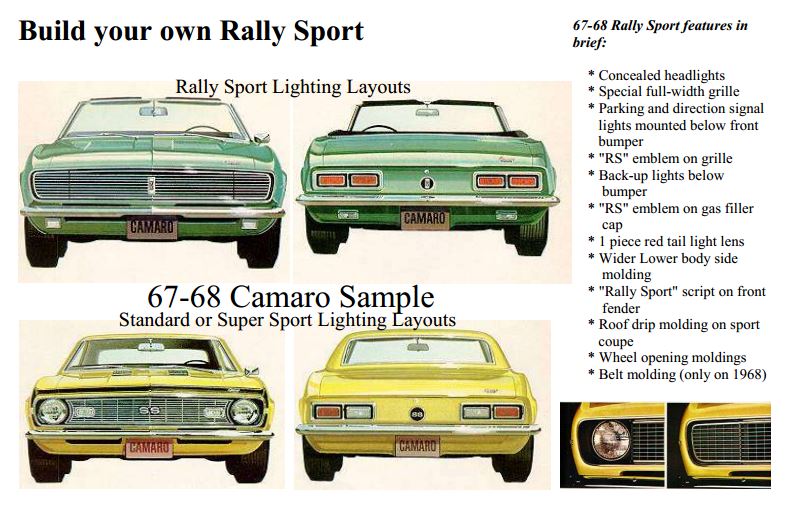
1967 - 1969 Camaro Parts - Rally Sport Conversion Kits Available Now - Order Now - Steve's Camaro Parts - 650-873-1890


These have been on back order and are now in stock. Don't miss out. Also, check out our online store at www.stevescamaroparts.com and load the shopping cart. Call us at 800-544-4451 with the order and if it meets the above stated requirements we will ship via UPS ground to you.

67 Camaro, Rally Sport Front Conversion kit, This kit consists of the finest parts available in the marketplace today.

67 Camaro, Rally Sport Front Conversion kit

You will receive 2 completely assembled headlamp assemblies, 2 grille moldings(upper and lower), 1 grille(center), 2 fender bezels, 2 complete RS Front parking lamp assemblies, 1 RS Hood release , 1 RS lower valance, 2 RS fender adapter brackets, 2 headlamp motors(USA made), all needed disc and washers for headlight motors, 4 limit switches, 4 limit switch brackets and hardware needed for them , 1 circuit breaker, 1 relay board, 3 RS relays (pre-assembled), 1 RS headlamp harness, 1 diode harness
with this kit you convert you're STD fenders to RS with the adapter the best way if you have those hard to find good fitting GM fenders or if you need fenders that choice is below for you also

If you can't find what you are looking for call and ask for Steve.


YOU ARE NOT JUST BUYING PARTS – YOU ARE GETTING OUR CAMARO EXPERTISE

Don't miss shopping on our website cart - http://shop.stevescamaroparts.com/

Do you find Shipping to be overpriced?  Call at 800-544-4451 and we can probably get yo a better shipping rate!

http://www.stevescamaroparts.com

Friday, October 3, 2014

1967 - 1969 Camaro Parts - The Chevy Camaro first hit the streets on this date in 1966 - Steve's Camaro Parts - 650-873-1890


1967 Chevy Camaro
1967 Chevy Camaro

Even before Ford launched the Mustang in 1964, executives at General Motors knew they'd need a stouter two-door sports car than the Corvair. The idea percolated inside the company under the code name XP-836; it was often known as the Panther, and at least one mockup carried the name Chaparral, borrowed from Chevy's successful Trans-Am racers. The name had been revealed in June of 1966, and with a slow rollout to build anticipation, Chevy put the Camaro — a name derived from an obscure French-English dictionary that supposedly meant "friend" — on sale on this date in 1966. That first generation offered a choice of eight engine setups, including the stonking 427 V-8, and three trim levels, with the Z/28 edition coming a year later. It's one of the most classically perfect designs GM has ever produced, and has lost none of its power in the nearly five decades since its launch. Here's the first ad for the Camaro, something that hasn't worn as well:


Photo: Douglas Pittman via Motoramic group on Flickr
source: Motoramic
by Justin Hyde


If you can't find what you are looking for call and ask for Steve.


YOU ARE NOT JUST BUYING PARTS – YOU ARE GETTING OUR CAMARO EXPERTISE

Tags: camaro part, camaro parts, Camaro restoration parts, 69 camaro, 1969 camaro, aftermarket camero parts, chevrolet camaro, ss, z28, rs, chevrolet, restoration, 68 camaro, chevy, 67, 69, f-body, camaro, chevy camaro, chevrolet camaro, gm, z-28, 350, ls1, z/28, pace car, camaro ss, 69 camaro, first generation, copo, fbody, yenko, 67 camaro, 68 camaro, musclecar 

http://www.stevescamaroparts.com

Friday, April 4, 2014

Classic Camaro Parts - What Small block Engines were available for First Generation Camaros - Steves Camaro Parts San Bruno - 650-873-1890


What were the Small Block engines available for First Gen Chevy Camaros?
 
307 in³ (5.0 L) version was produced from 1968 through 1973. Engine bore was 3.875 in (98.4 mm) with a 3.25 stroke.
The 307 replaced the 283 in Chevrolet cars and produced 200 hp (149 kW) SAE gross in the 1960s. The later emissions-modified versions produced just 115 hp (86 kW) SAE net, giving the engine one of the lowest power-per-displacement ratings of all time. Chevrolet never produced a high-performance version of this motor.
(Chevrolet produced for Outboard Marine Corporation, a high-performance marinized 307, rated at 235 and 245 hp SAE gross, depending on year, that shipped with the Corvette/Z-28's cast aluminum valve covers and Rochester QuadraJet carb. Chevy also built other versions of the OMC 307 rated at 210, 215 and 225 horsepower SAE gross.)
The 307 was also unique in the fact that its casting alloy had a very low nickel content making it relatively soft. Due to this fact, this engine has low value among rebuilders because of reduced longevity.
The 327 in³ (5.4 L) V8, introduced in 1962, was bored and stroked to 4 in (102 mm) by 3.25 in. Power ranged from 250 hp to 375 hp (186 kW to 280 kW) depending on the choice of carburetor or fuel injection. In 1962, the Duntov solid lifter cam versions produced 340 hp (254 kW), 344 ft·lbf (466 N·m) with single Carter 4-brl, and 360 hp (268 kW), 352 ft·lbf (477 N·m) with Rochester mechanical fuel injection. In 1964, horsepower increased to 365 for the now dubbed L76 version, and 375 for the fuel injected L84 respectively, making the L84 the most powerful naturally aspirated, single-cam, production small block V8 until the appearance of the 385 hp (287 kW), 385 ft·lbf (522 N·m) Generation III LS6 in 2001. * L76, L84 1963-1965; Chevrolet Corvette. This block is one of 3 displacements that underwent a major change in 1968/1969 when the main bearing size was increased from 2.30 in to 2.45 in.
The 350 in³ (5.4 L) V8. The first generation of Chevrolet small-blocks began with the 1955 Chevrolet 265 in³ (4.3 L) V8. But it was the 350 in³ (5.7L) series that set the standard for high performance. The engine's physical dimensions (oversquare 4.00 in bore and 3.48 in stroke, 102 mm by 88 mm) are nearly identical to the 400 hp (300 kW) LS2 engine of today, but of course much has changed. It is by far the most widely used Chevrolet small-block; it has been installed in everything from station wagons to sports cars, in commercial vehicles, a nd even in boats and (in highly modified form) airplanes!
A 350 is usually common with engine swaps - much of the older, pre-1968 Chevrolet V8s were usually swapped with a later 350 when engine replacement was the norm. It has been known to swap a 350 in place of a 305 since the 350 is part of the same engine family (the external dimensions of a Chevrolet small block are the same).
First usage of the 350 was in the 1967 Chevrolet Camaro and 1968 Nova producing 295 horsepower (gross); other Chevrolet vehicle lines followed suit in the year 1969.
The GM Goodwrench 350 crate motor (sold through Chevrolet dealerships) is based on the pre-1986 small block design with two dipstick locations; pre-1980 on the driver's side and post-1980 on the passenger's side. This motor was produced in Mexico since 1981 as the Targetmaster 350.
Note that Buick, Oldsmobile, and Pontiac all produced three entirely different 350 in³ V8 engines that shared nothing in common other than displacement. The Buick 350 had a 3.80 in bore and a 3.85 in stroke (96.52 mm by 97.91 mm), the Oldsmobile 350 had a 4.057 in bore and 3.53 in stroke (103 mm by 90 mm), and the Pontiac 350 had a 3.876 in bore and a 3.75 in stroke (98.5 mm by 89.66 mm).
The 302 in³ (5.4 L) V8 engine was only available in first-generation Z-28s (the 350 LT-1 was used in 2nd generation Z-28s), and was created in response to a Trans Am racing engine displacement limitation at that time of 5 litres (305ci). The 302 was created by installing a short-stroke 283ci engine crankshaft in a 327ci block, resulting in 302ci. This just fit the Trans Am limitation (the bores of the actual racing engines were tweaked to produce exactly 305ci) and this design (with special modifications for high-performance use) resulted in an unusual, high-revving engine that helped create the legend of the Z-28. The 302 was the only engine available in the first-generation Z-28.
L26 230ci/140HP L6 1BC - non-SS
L22 250ci/155HP L6 1BC - non-SS
Z28 302ci/290HP V8 4BC - Z-28 only
L14 307ci/200HP V8 2BC - non-SS, 1969 only
LF7 327ci/210HP V8 2BC - non-SS, eliminated during 1969
L30 327ci/275HP V8 4BC - non-SS, 1967-68 only
L65 350ci/250HP V8 2BC - non-SS, 1969 only
LM1 350ci/255HP V8 4BC - non-SS, regular fuel, 1969 only
L48 350ci/295HP V8 4BC - SS only, rated 300HP in 1969


No Other Camaro Supplier in the Business Comes Close to Our Selection.  We have been serving the Camaro Community since 1976 and Supplying Camaro Parts since 1981.


 YOU ARE NOT JUST BUYING PARTS – YOU ARE GETTING OUR CAMARO EXPERTISE


Tags: camaro part, camaro parts, Camaro restoration parts, 69 camaro, 1969 camaro, aftermarket camero parts, chevrolet camaro, ss, z28, rs, chevrolet, restoration, 68 camaro, chevy, 67, 69, f-body, camaro, chevy camaro, chevrolet camaro, gm, z-28, 350, ls1, z/28, pace car, camaro ss, 69 camaro, first generation, copo, fbody, yenko, 67 camaro, 68 camaro, musclecar, second generation

http://www.stevescamaroparts.com
 

Copyright 2011 2008-2011. Steve's Camaros.

Wednesday, March 12, 2014

Classic Camaro Parts - Mono-leaf and Multi-leaf Spring Usage - Steves Camaro Parts San Bruno - 650-873-1890


Mono-leaf and Multi-leaf Spring Usage
 

All 6-cylinder cars for all 3 years came with mono leaf springs.

All 1967 models used mono leaf design rear springs.

For 1968, only models with the 12-bolt rear end received multi-leaf springs. This included all SS models, the Z28, and the L30/M20 327/275hp 4-speed. All other 1968 models used monoleaf springs.

In 1969, all models with 12-bolt axles received multi-leaf springs and all models with 350ci engines (10- or 12-bolt) received multi-leaf springs. Vehicles with 307 and 327 engines received mono-leaf springs.

The spring rates varied depending on the model, vehicle weight, and spring options (F41 and G31). The spring part numbers and weight ranges are shown in the parts manuals and the ride heights are shown in the Assembly Instruction Manual. Note that not all spring part numbers were sold as service parts and not all are not reproduced.


Upper A-Arms
The upper a-arms used for all 67-68 Camaros and 69 Camaros with drum brakes and JL8 four-wheel disc brakes were the same design. The 69 J52 disc brake cars used the same basic part, but there were two holes added to the trailing side of the a-arm for mounting a support for the brake hose.

Lower A-Arms
The lower a-arms used for the 1st-gen Camaros had small but noticeable differences for all three years. This was primarily due to changes in the location of the rubber bump stop which was used to cushion any contact with the frame upon full compression of the suspension. It is unknown why the location of the rubber bump stop changed each year.

In 67, the rubber bump stop was mounted on a bracket which was welded to the frame, thus there is no rubber piece mounted on the lower a-arm and no holes drilled in the a-arm to do so.

For 68, a newly designed larger rubber bump stop was mounted (through two drilled holes) on the trailing side of the a-arm. The mounting bracket for the rubber bump stop (which had been in-line with the centerline of the wheel in 67) was removed and a newly designed metal contact pad for the rubber bump stop was mounted on the trailing side of the coil spring pocket on the frame.

For 69, the same rubber bump stop was moved to the leading edge of the lower a-arm and the corresponding metal contact pad on the frame followed suit to the leading side of the coil spring pocket. All service replacement a-arms included mounting holes for both the 68 and 69 positioning of the rubber bump stop.
Obviously, these holes are not relevant for the 67 application since the rubber piece is on the frame.


The 67 and 68 lower a-arms use welded-in nuts for the lower shock mount. For 69 and for all service replacement a-arms, the shock mounting nuts were attached by a J-clip, which simplified the nut installation and also allowed for easy replacement.

The Assembly Instruction Manuals for all three years show different part numbers for the lower a-arm assembly for drum brakes and the lower a-arm assembly for disc brakes. Despite analysis of the parts, the difference is unknown; it may involve another component of the a-arm assembly.
source: http://www.firstgencamaro.com/suspension.html


No Other Camaro Supplier in the Business Comes Close to Our Selection.  We have been serving the Camaro Community since 1976 and Supplying Camaro Parts since 1981.

 YOU ARE NOT JUST BUYING PARTS – YOU ARE GETTING OUR CAMARO EXPERTISE


Tags: camaro part, camaro parts, Camaro restoration parts, 69 camaro, 1969 camaro, aftermarket camero parts, chevrolet camaro, ss, z28, rs, chevrolet, restoration, 68 camaro, chevy, 67, 69, f-body, camaro, chevy camaro, chevrolet camaro, gm, z-28, 350, ls1, z/28, pace car, camaro ss, 69 camaro, first generation, copo, fbody, yenko, 67 camaro, 68 camaro, musclecar, second generation

http://www.stevescamaroparts.com

Tuesday, November 26, 2013

Classic Camaro Parts - 1969 Camaro Parts & Restoration Specifications - Steves Camaro Parts San Bruno - 650-873-1890


1969 Pace Car Camaro
 

1969 Camaro Parts & Restoration Specifications

The 1969 Camaro marked the last of the first generations and is arguably the most popular. While it shared the same basic body style as its earlier siblings, it featured entirely new, more aggressive looking sheet metal and an entirely revised grille. The familiar coke bottle shape was flatted more to give the 1969 Camaro a lower and wider looking stance. The grille was much more angled and the parking lamps were moved to the lower front valance below the bumper. Other than the roof itself, the 1969 Camaro doesn’t share very much sheet metal with earlier models.

The 1969 Camaro was available in many different configurations. From a plain Jane sport coupe to asphalt eating Super Sport, there was something for everyone! All 1969 Camaros shared the same body unlike the Chevelle and were available in either coupe or convertible. Buyers could choose from the base model Sport Coupe, drag strip ready Super Sport, or road racing Z-28. The Rally Sport option with hidden headlights could be added as a separate packing to any of those models.

Interiors were only available with bucket seats and were available in a variety of colors and styles. Standard interiors were available in Black, Dark Blue, Red, White, Light Green, or Dark Metallic Green. Buyers who ordered a deluxe interior received unique door panels with molded in arm rests and Comfortweave seats with color choices of Black, Dark Blue, Light Green, Dark Metallic Green, or Red. Even rarer was the deluxe Houndstooth interior with unique pleats in Black, Orange, Yellow, or White. A fold down rear seat was available but very rare. An optional console was available with our without gauges. The buyer could have ordered a number of different exterior colors including Tuxedo Black, Butternut Yellow, Dover White, Dusk Blue, Garnet Red, Glacier Blue, Azure Turquoise, Fathom Green, Frost Green, Burnished Brown, Champagne, Olympic Gold, Burgundy, Cortez Silver, LeMans Blue, Hugger Orange, Daytona Yellow, or Rallye Green. Two tone color combinations were available in Glacier Blue/Dover White, Azure Turquoise/Dover White, Glacier Blue/Dusk Blue, Dusk Blue/Glacier Blue, Olympic Gold/Dover White, and Burnished Brown/Champagne.

To complement the wide variety of available colors were the available drive train combination's that could be opted for on the 1969 Camaro. Base power was had by one of two available six cylinder engines. Buyers who wanted more power could opt for a V-8. Manual transmissions were either 3 speeds or 4 speeds. The 2 speed Powerglide was the standard transmission and a 3 speed Turbo Hydramatic was optional.

About 243,000 1969 Camaros were produced.

1969 Camaro
Models
1969 Camaro Standard Sport Coupe
1969 Camaro Rally Sport (hidden headlights)
1969 Camaro Super Sport
1969 Camaro Rally Sport Super Sport (RS/SS)
1969 Camaro Z/28
1969 Camaro Rally Sport Z/28 (RS/Z/28)

Body Styles
2 Door Coupe
2 Door Convertible (except Z/28) 

Engine Options
230 cubic inch 140 horsepower 6 cylinder (base)
250 cubic inch 155 horsepower 6 cylinder (optional)
302 cubic inch 290 horsepower V8 (base Z/28, Z/28 only)
307 cubic inch 200 horsepower V8 (base)
327 cubic inch 210 horsepower V8 (replaced by 307 January 69’)
350 cubic inch 255 horsepower V8 (optional, dropped midway)
350 cubic inch 250 horsepower V8 (optional late in the year)
350 cubic inch 300 horsepower V8 (base Super Sport, SS only)
396 cubic inch 325 horsepower V8 (optional Super Sport, SS only)
396 cubic inch 350 horsepower V8 (optional Super Sport, SS only)
396 cubic inch 375 horsepower V8 (optional Super Sport, SS only)
427 cubic inch 430 horsepower V8 (Central Office Production Order COPO)
427 cubic inch 435 horsepower V8 (Central Office Production Order COPO)


No Other Camaro Supplier in the Business Comes Close to Our Selection.  We have been serving the Camaro Community since 1976 and Supplying Camaro Parts since 1981.

 YOU ARE NOT JUST BUYING PARTS – YOU ARE GETTING OUR CAMARO EXPERTISE


Tags: camaro part, camaro parts, Camaro restoration parts, 69 camaro, 1969 camaro, aftermarket camero parts, chevrolet camaro, ss, z28, rs, chevrolet, restoration, 68 camaro, chevy, 67, 69, f-body, camaro, chevy camaro, chevrolet camaro, gm, z-28, 350, ls1, z/28, pace car, camaro ss, 69 camaro, first generation, copo, fbody, yenko, 67 camaro, 68 camaro, musclecar, second generation

Friday, November 15, 2013

Classic Camaro Parts1st Generation - RallySport Hose Routing Diagrams - Steves Camaro Parts San Bruno - 650-873-1890


No Other Camaro Supplier in the Business Comes Close to Our Selection.  We have been serving the Camaro Community since 1976 and Supplying Camaro Parts since 1981.

 YOU ARE NOT JUST BUYING PARTS – YOU ARE GETTING OUR CAMARO EXPERTISE


Tags: camaro part, camaro parts, Camaro restoration parts, 69 camaro, 1969 camaro, aftermarket camero parts, chevrolet camaro, ss, z28, rs, chevrolet, restoration, 68 camaro, chevy, 67, 69, f-body, camaro, chevy camaro, chevrolet camaro, gm, z-28, 350, ls1, z/28, pace car, camaro ss, 69 camaro, first generation, copo, fbody, yenko, 67 camaro, 68 camaro, musclecar, second generation

Thursday, September 19, 2013

1967 - 1969 Camaro Parts - First Generation R/S Conversion Kits - Steves Camaro Parts San Bruno - 650-873-1890


We have built the most complete and technically correct R/S conversion kits available...DON'T be fooled by others on the web who throw in Books, nuts and bolts and then list everything separately to make there kits look better!!!To have a real R/S conversion you need it all, front valance, park lamps,R/S hood release..After all how are you going to open your hood when you can't reach the hood release??
 

And to really step up to the plate R/S the back end of your ride also with R/S Backup lamps the proper tail lamps..kick in the Rocker mouldings and the R/S front end fastner kit. And it will be so real they'll think the VIN numbers are wrong!! Look at everything the kit has then shop the others. ASK THEM! What else you need to finish the kit...add in all the right parts you need to finish your ride!..

Then come back


YOU ARE NOT JUST BUYING PARTS – YOU ARE GETTING OUR CAMARO EXPERTISE


http://www.stevescamaroparts.com


Tags: camaro part, camaro parts, Camaro restoration parts, 69 camaro, 1969 camaro, aftermarket camero parts, chevrolet camaro, ss, z28, rs, chevrolet, restoration, 68 camaro, chevy, 67, 69, f-body, camaro, chevy camaro, chevrolet camaro, gm, z-28, 350, ls1, z/28, pace car, camaro ss, 69 camaro, first generation, copo, fbody, yenko, 67 camaro, 68 camaro, musclecar

Wednesday, September 18, 2013

1967 - 1969 Camaro Parts - 1967 Chevrolet Camaro - The Lost Z/28 - Steves Camaro Parts San Bruno - 650-873-1890


The name Z28 started out as only a Regular Production Order (RPO) option code but has since grown into one of the most recognizable three letters in Camaro automotive history. It may just be a coincidence that the RPO code for the Camaro Super Sport (SS) package was Z27 and that RPO Z28 just followed it sequentially or maybe not. Whatever the case may be it was nothing more and nothing less than a RPO option code at first.

Some people mistakenly believed that the Z in Z28 stood for Zora Arkus-Duntov the Corvette engineer. Actually a man named Vincent W. Piggins (more on him later) had put a name on the original 283 “Z28″ prototype Camaro before he presented it at a October 1966 “show-and-tell” session with top management at the GM Proving Grounds. The name that he had chosen was Cheetah. However at the last moment Vincent took the handmade decal off the car mumbling something like, “Well, a name is a name is a name.”

“There wasn’t any suggestion of what we were going to call this car,” recalls Vincent. “When it came down to having to decide, somebody just said, `Hey, it’s option RPO Z28; let’s call it Z28!’ So the name just grew from there. The graphics people did things with the Z, and that’s how the designation stuck. The car got its name from the actual option number.”

So who is Vincent W. Piggins you ask? Well he was a veteran Chevy engineer who designed the Z28 expressly for the Trans-America sedan series races along with convincing Chevrolet/GM management to sell it to the public. In fact, without Vincent’s efforts, the Sports Car Club of America’s (SCCA) might never have continued Trans-America sedan competition at all. Had it not been for Vincent’s assurance to SCCA officials that Chevrolet would lend its support there may not have been a Trans-Am sedan series race schedule for 1967.

Vincent had been a Chevrolet engineer since 1956 and was the man behind the Hudson Hornet’s NASCAR championships in the early 1950′s. The following is his explanation of the Z28′s creation:

“After Ford released the Mustang, they had about two years on us before Chevrolet could get the Camaro into the 1967 product line. I felt in my activity, which deals with product promotion and how to get the most promotional mileage from a car from the performance standpoint, that we needed to develop a performance image for the Camaro that would be superior to the Mustang’s.

“Along comes SCCA in creating the Trans-Am sedan racing class for professional drivers in 1966, aimed at the 1967 season. I made it a point to have several discussions with SCCA officials-notably Jim Kaser, John Bishop, and Tracy Byrd-and one thing led to another. I suggested a vehicle that would fit this class and, I believe … supported by what Chevrolet might do with the Camaro … it gave them heart to push ahead and make up the rules, regulations, and so forth for the Trans-Am series. I feel this was really the creation of the Trans-Am as we know it.”

“This was “sedan racing,” mind you, and what qualified the Camaro and all ponycars as “sedans” was the fact that they had rear seats. And although Chevrolet sold only 602 Z28′s during 1967, they met the 1000 production rule by homologating the 350-cid Camaro under FIA Group I rules and then qualifying the same basic vehicle with the Z28 option under Group II.”

“Now on August 16, 1966, ” continues Piggins, “I put together a memo to my boss, W.T. Barwell, that laid out the basic idea of the Z-28, although, of course, it wasn’t called that then.

“This memo went out to engineers Alex Mair and Don McPherson, sales manager Bob Lund, Joe Pike in sale promotion, and C.C. Jakust. I said, in effect, that SCCA sedan racing was becoming increasingly popular and would blossom into even bigger things with the advent of the short-wheelbase, Mustang type pony car.

“My proposal went on that since our projected engine lineup for the 1967 Camaro had no V-8 smaller than the 327, and since we were above the 5000cc (305-cid) SCCA displacement limit for Class A sedans, we ought to take a high-performance version of the old 283 and wrap an option package around it to make it competitive within SCCA. You’ll remember that the Barracuda was running a 273 V-8 at that time, and the Mustang’s competitive engine was the 289. So our high-performance 283 would certainly have been right in there.”

The key portions of Piggins’ Aug. 17 memo said, “A new 283 high-performance engine plus other relative drive line and chassis items will provide performance and handling characteristics superior to either Mustang or Barracuda. To aid in the merchandising of this vehicle, certain other embellishments have been included to make the overall vehicle immediately identifiable and distinctive. The sales department anticipates a volume of 10,000 such vehicles could be sold in 1967.”

Piggins continues his explanation: “My initial proposal suggested we use the 283 V-8 plus the F-41 optional suspension, with heavy-duty front coils and multi-leaf rear springs. I also requested the J-52 front disc brakes with J-65 metallic linings for the rear drums, the 11-inch clutch from the 396 V-8, the close-ratio 4-speed with 2.20 low, a brand-new steering gear with a 24:1 overall ratio, Corvette 15 x 6 wheels with 7.75 tires, and a special reworked hood to provide functional air intake. There were other modifications called for as well, and 1 suggested we make the package available only in the Camaro coupe, not the convertible, and that the Z-22 Rally Sport option form part of the equipment for this car. Now not all this equipment went into the production Z-28 automobile, but those were the initial parts called for.”

Piggins got permission to have a pre-production Z-28 prototype built to these initial specifications. One of his first passengers in the as-yet-unnamed Z-28 was Chevrolet’s new general manager, Elliott M. (Pete) Estes. The ride didn’t come until just before noon. After some full-throttle acceleration runs and a few dives through a slalom course, Piggins let Estes take the wheel.

“Estes was quite impressed with the performance of this 283 engined vehicle,” recalls Piggins, “and as I explained to him what we planned to do to capture the Trans-Am championship and to produce a good performance image for the Camaro, it didn’t take much convincing for Pete to see what I was aiming toward.

“The only thing. . .” says Vincent, “while we were driving the car, I mentioned that we’d put the 283 into it because we’d built that size engine before. But I suggested when we got back to the starting pad that it might be a lot better to take the 327 block and put the 283 crank into it, giving us a 4 x 3 bore and stroke. That would put displacement at 302.4 cid, just under the SCCA’s 305 limit.” This configuration produced a high revving 302 cid small-block with a modestly rated 290 bhp (probably more like 350hp) and 290 pound-feet of torque (probably more also).

“So Pete immediately agreed, especially being an engineer and knowing the potential this car could have. Estes walked over to engineers Alex Mair and Don McPherson and said, `Let’s release this package and develop a 302 engine to go with it.’

“That was really the start of the Z28, and we proceeded to homologate that vehicle with the FIA as of Jan. 1, 1967 as a Group II car.” Even before that happened Chevrolet built a prototype 302 engined show car and displayed it for the motoring press at a special preview. This preview was held at Riverside International Raceway in California in November 1966 at the end of the ARRC events.

Chevrolet’s public relations person Walt Mackenzie set up a special track side tent at Riverside that had a technical news handout. It showed the Camaro coupe with what was called simply Regular Production Option (RPO) Z28. Magazine writers and editors from publications such as Motor Trend, Road & Track, Car & Driver, Sports Car Graphic, Hot Rod just to name a few were allowed to drive this first Z28. They all loved the car publishing rave reviews soon afterward.

What helped transport the Camaro from a wanna be to real competition for sedan sports car sales was the fact that the Camaro was successful at the track, beating the Mustang on a regular basis. Of course, the Z28 that the public could buy at their local Chevrolet dealership was not anywhere close to being the race-ready car that won SCCA championships. The race winner was, however, the basis for the cars that were made available to the public. The more racers learned about what they needed to win, the more Chevrolet was able to offer as performance parts for the Z28′s. For example, the Penske/Donohue race team was hugely responsible for bringing many heavy duty performance upgrades to dealers’ parts counters since any part that was used on the Z28′s being raced was required to be made available to the public.

One of the amazing facts of the first gen Z28 was its warranty. Chevrolet didn’t flinch and applied the same 2year/24,000-mile warranty to the Z28 automobile as a whole and its 5-year/50,000-mile warranty to the powertrain. That went beyond expectation and contrary to the practice of warranties for most high performance packages.

Posted in April 17th, 2008by Letz Roc in Z28's 1st Gen
YOU ARE NOT JUST BUYING PARTS – YOU ARE GETTING OUR CAMARO EXPERTISE


http://www.stevescamaroparts.com


Tags: camaro part, camaro parts, Camaro restoration parts, 69 camaro, 1969 camaro, aftermarket camero parts, chevrolet camaro, ss, z28, rs, chevrolet, restoration, 68 camaro, chevy, 67, 69, f-body, camaro, chevy camaro, chevrolet camaro, gm, z-28, 350, ls1, z/28, pace car, camaro ss, 69 camaro, first generation, copo, fbody, yenko, 67 camaro, 68 camaro, musclecar

Wednesday, September 11, 2013

1967 - 1969 Camaro Parts - Vacuum Actuated Headlamp Doors - Steves Camaro Parts San Bruno - 650-873-1890


�Vacuum Actuated Headlamp Doors�
1969 RPO Z22


Brief History:
All three years of the first generation Camaro were available with the RPO Z22
�Rally Sport�
option. Any Camaro could be ordered with the desirable hidden headlights starting with the most modest inline 6 cylinder right on up the food chain to the powerful COPO. In 1967 the headlight doors were opened and closed by electric motors, which Chevrolet quickly replaced with a vacuum actuated system in 1968. I do not know if the 1968 system was revised in 1969. This means if you have a 68 RS Camaro use this information cautiously and have the correct year manuals referenced below to be sure...

Reference Material:
The Vacuum actuated headlight doors are just one of the features included on the 1969 (RPO Z22) Rally Sport Camaro. The intent of this tech feature is to aid you in understanding how this very simple vacuum circuitry is plumbed and works. Please reference the 1969 Camaro Factory Assembly Instruction Manual
�
(AIM) RPO Z22 B6 (page 462) for part numbers and proper installation of hardware and routing of hoses.
The diagram I have included has been laid out in a way that depicts proper connections of hoses and components based on the AIM and will give you a feel for where everything belongs. They are not intended to show mounting and proper physical placement. For additional reference, the 1969 Chevrolet Chassis Service Manual (CSM) also has information that may be of assistance to you (Section 12: Electrical-Body and Chassis: Lighting Systems starting on page 12-6 Vacuum Operated Headlamp Service
�).

Getting Started:
Take a good look at the diagram; let's start with the vacuum source. You will find a vacuum line running from a fitting on the intake manifold across the firewall toward the driver side fender (the black hoses on the diagram).


Click Here to open diagram in a new window.

Note: Hoses are black or black with colored stripes and are as depicted in the AIM. These colors concur with the CSM with the exception of one of the black hoses, which is shown with a white stripe. I chose to default to the AIM for correctness as the CSM represents several of the Chevrolet line up with hidden headlights.

With the engine running, the headlights off and the override switch in the normal position there will be vacuum present on the black hoses, the yellow-striped hoses, the Vacuum Tank and the middle port of the Vacuum Relay. You will also find vacuum present through the headlight switch and on the orange-striped hose from the headlight switch to the Vacuum Relay and the green-striped hoses to the actuators. The doors will be closed under these conditions.
Take note of the one way check valve or "Vacuum Line Filter" (much like the one used in the power brake booster system) placed in the main vacuum line coming from the intake manifold. It keeps the system (black, orange, yellow and green-striped hoses) holding about 10" of vacuum when the engine is shut off. That is based on what I measured on my own system. At this point there is no vacuum present on the red-striped hoses.

The Operation:
The headlight doors operate (open) when the headlight switch is pulled out to the second position (headlights on) cutting off the vacuum to the orange-striped hose. This operates the Vacuum Relay removing vacuum from the green-striped hoses and placing vacuum on the red-striped hoses to the actuators. This can also be accomplished by operating the over ride switch (pushing in the plunger) which plugs the orange-striped hose, removing vacuum at that point (same result as turning on the headlights).

Testing:
To test the system, start the engine and push the override plunger switch in on the Vacuum Relay, the doors should open. Pull out the plunger on the override and the doors should close. Do the same from the headlight switch. If they don't open and close properly, or at all, make sure the mechanical parts of the doors are adjusted and working smoothly before tearing into the plumbing.
Assuming the mechanical parts all function properly you now know where vacuum should be under open and closed conditions. Trouble shoot by unplugging one hose at a time and verifying that vacuum is present or not. Reproduction actuators have had a bad rap in the past so you might want to start there. Verify the switches (Headlight and Vacuum Relay) are doing what they are supposed to as well. Hose kits have been known to have the ends get brittle and crack before they even get taken out of the box they are packed in so be alert for vacuum leaks too. If low idle vacuum is a concern, vacuum should increase with rpm so set your idle up a bit if you have to for testing.

End Results:
It's a great feeling knowing your headlight doors open and close properly, it's the little pleasures in life, isn't it? Special thanks go out to Team Members Chad Renfro (CA420) and Todd Bradford (DTB) whose research and willingness to share their knowledge with TC has assisted me greatly with this tech reference page. Thanks guys! 
 
YOU ARE NOT JUST BUYING PARTS – YOU ARE GETTING OUR CAMARO EXPERTISE
 
Available at Steves Camaro Parts


Tags: camaro part, camaro parts, Camaro restoration parts, 69 camaro, 1969 camaro, aftermarket camero parts, chevrolet camaro, ss, z28, rs, chevrolet, restoration, 68 camaro, chevy, 67, 69, f-body, camaro, chevy camaro, chevrolet camaro, gm, z-28, 350, ls1, z/28, pace car, camaro ss, 69 camaro, first generation, copo, fbody, yenko, 67 camaro, 68 camaro, musclecar 

Http://www.stevescamaroparts.com